Three Good Things Book Review + Homemade Kringle

In January, I won a copy of the newly released novel Three Good Things through a Goodreads giveaway. The story is about serendipity, and I consider it serendipitous that I won because I was craving a light, fun read after spending two full days preparing my tax returns. This novel is great for a lazy Sunday afternoon, and a relatively quick read at 235 pages. There’s also a discussion guide at the end, making this a good pick for book clubs.

Jacket

Three Good Things is centered around the lives of three main characters in small town Wisconsin. There’s Ellen McClarety, a recent divorcée in her mid-40s who has recently opened a small bakery that specializes in the Danish pastry, the kringle. Her younger sister, Lanie Taylor, is a family law attorney in nearby Madison and an overprotective new mom to 10-month-old Benjamin. Lanie’s husband, Rob, is a hard-working architect, who feels under-appreciated by his firm.

None of these characters is especially extraordinary, and that is the beauty of the book. As they go about their daily lives, struggling to achieve balance and a sense of peace, Ellen and Lanie remember a piece of advice their long-deceased mother had told them: “At the end of every day, you can always think of three good things that happened.” It is through experiencing gratitude in the small things that we truly find peace and purpose in our lives.

As much of the story takes place in Ellen’s bakery, it is fitting that a recipe for Danish Kringle is included at the end of the book. Of course, I had to try it. While traditionally in Denmark the kringle is similar to a pretzel, in the Americanized version that’s featured in Three Good Things it is a long pastry filled with fruit and/or nuts. I made the apple version that is featured in the recipe, but once you master the technique, it would be easy to try other concoctions such as blueberry, raspberry or rhubarb. With its light, flaky, buttery crust, the kringle is reminiscent of a croissant, yet it only takes about 3 hours to make compared to the nearly 3 days it takes for the perfect croissant.

For ingredients, you will need ¾ cup butter (1 ½ sticks), 3 ¼ cups all-purpose flour (I used unbleached white), 1 package active dry yeast, 2 eggs, ¾ cup of milk, 3 tablespoons sugar (I used organic cane sugar), 1 teaspoon salt, 1 ½ cups of chopped and peeled apples, ½ cup brown sugar or coconut palm sugar (I prefer the latter because it is minimally processed), ½ cup powdered sugar, 2 teaspoons milk, ¼ cup sliced and toasted almonds.

To begin, cream the butter with ¼ cup of flour. Place between 2 sheets of parchment paper and roll to a 10 x 4 inch rectangle. Place in refrigerate to chill. Soften yeast in ¼ cup of warm water (it is important the water temperature is ca. 100-110*F so the yeast does not die). In a large mixing bowl, combine 1 egg, ¾ milk, 3 tablespoons sugar, 1 teaspoon salt and yeast/water mixture. Add remainder of flour 1 cup at a time and knead until you have a soft, slightly sticky dough.

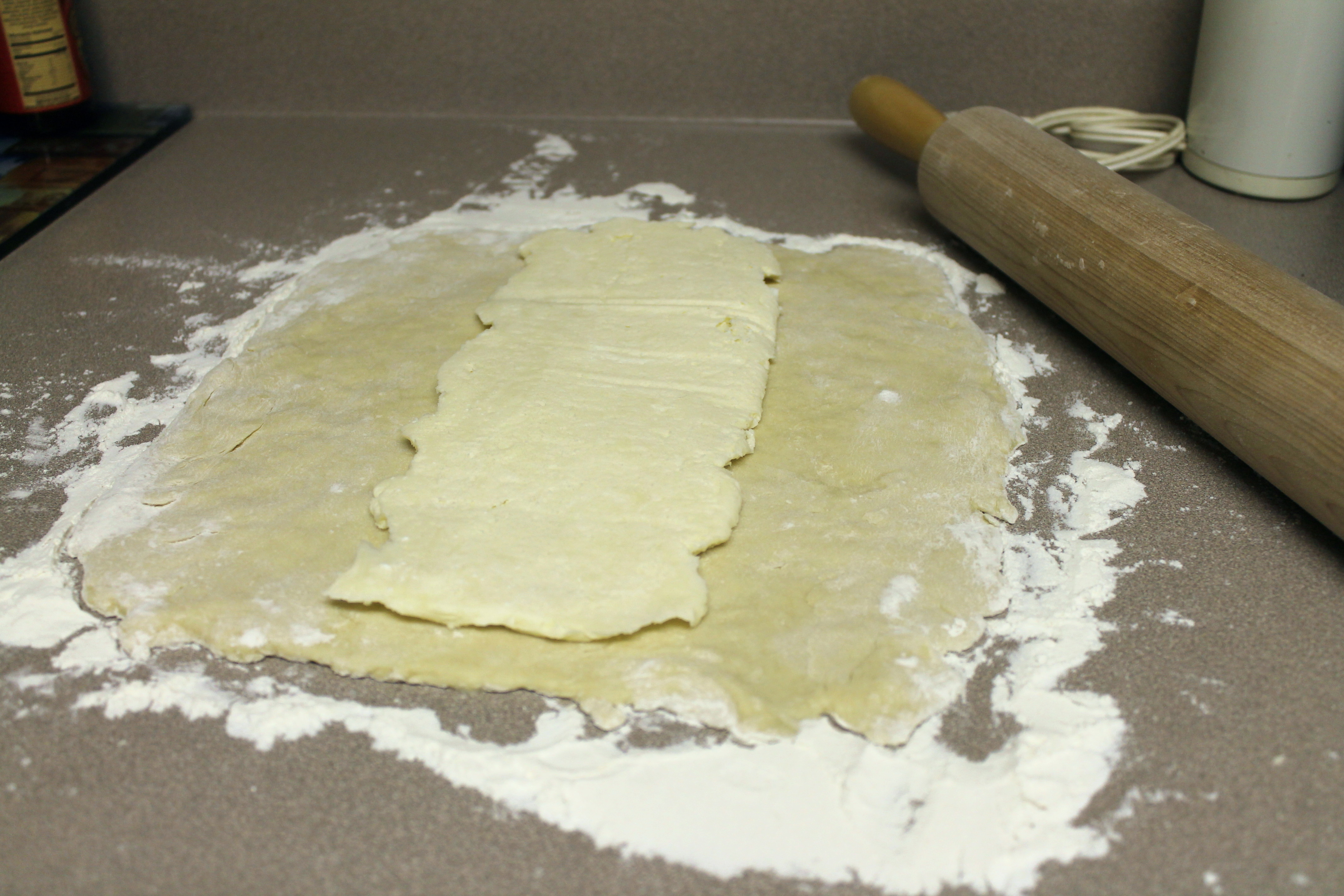
On a clean, floured surface, roll dough into a 12-inch square. Place chilled butter in center.
IMG_0968

Overlap sides of dough atop butter, turn dough ¼ way around, and roll into another 12-inch square.

IMG_0969

Repeat this process twice more. Wrap in parchment paper and chill for 30 minutes. Roll to a 24 x 12 inch rectangle and cut lengthwise into 2 strips (I used a pizza cutter). In a small bowl mix the apples and brown sugar or coconut palm sugar. Evenly spread each strip with filling.

IMG_0970

Moisten edges with water and seal. Stretch each pastry to approximately 30 inches without breaking. Shape into an oval and place on a greased baking sheet or non-stick baking sheet. Flatten to ½ inch with a rolling pin. Brush kringles with a beaten egg.

IMG_0971

Cover with plastic wrap and let rise until dough doubles, approximately 30 minutes to 1 hour. Preheat over to 375*F and bake for 25 to 30 minutes, until kringles are a golden brown.

IMG_0972

Cool on a wire rack. Meanwhile, mix up some icing with ½ cup powdered sugar and 2 teaspoons milk. Drizzle kringles with icing and top with toasted almonds.

IMG_0973

Voilà! Breakfast for the next week.
IMG_0976

Posted in DIY, Movie Reviews/Book Reviews, Recipes | Tagged , , , , , , | 1 Comment

Room Book Review

For February, my local book group read Emma Donoghue’s 2010 novel Room. The novel is a first person narrative, told from the point of view of 5-year-old Jack. At first I was a bit skeptical about reading it. I’d just returned a half-read book to the library, told from the point of view of a 7-year-old girl, because I didn’t find her voice believable (it sounded more like a 40-year-old trying to come across as a 7-year-old). However, that is definitely not the case with Room. For me, Jack’s narration is definitely childlike and he often ends sentences with words such as “yippee” and “delicioso.” I found his voice refreshing and entertaining, and the narration is what made it a 5 star book for me.

Jacket

I should back up a bit to talk about the plot. For the entirety of Jack’s short life, he and his “Ma” have never left an 11-foot by 11-foot shed. When she was 19-years-old, Ma was kidnapped by “Old Nick” (aptly named because he has a white beard), who makes nightly appearances in “Room” to deliver groceries and other supplies and use Ma as his sex slave. After 7 years in captivity, Jack is the only bright spot in her world, and she has done a damn fine job of raising him under their unfortunate circumstances. At 5 years, Jack has a tremendous vocabulary, can read and do complicated math. I was most impressed, however, by their Physical Education class, where they ran laps around Room, practiced karate, and played a host of other games to stay in shape in such a confined space.

Without giving too much of the plot away, I will say that events lead Ma to question how much longer they can stay in Room. The book is divided into five sections, each ending with an engaging cliff hanger. The reader will come to learn that Jack is the true hero of the story on multiple occasions.

To my surprise, the book had fairly mixed reviews on Goodreads. Apparently, many people found Jack’s narration annoying and others were disturbed by the subject matter. At least a handful of people were disturbed that Ma still breastfed her 5-year-old son, and I would like to ask them, “is that really what you found most disturbing about this book?”

Eight out of nine people in my book group gave Room a thumbs up. There is just something about a writer who dares to be different, who works against the standard formula that make up so many novels. Although Room is purely a work of fiction, I was horrified to learn of similar real life situations that have occurred recently in California and in Austria.

This is definitely a good pick for book groups and a story that will stick with me for quite some time.

Posted in Movie Reviews/Book Reviews | Tagged , , , | 1 Comment

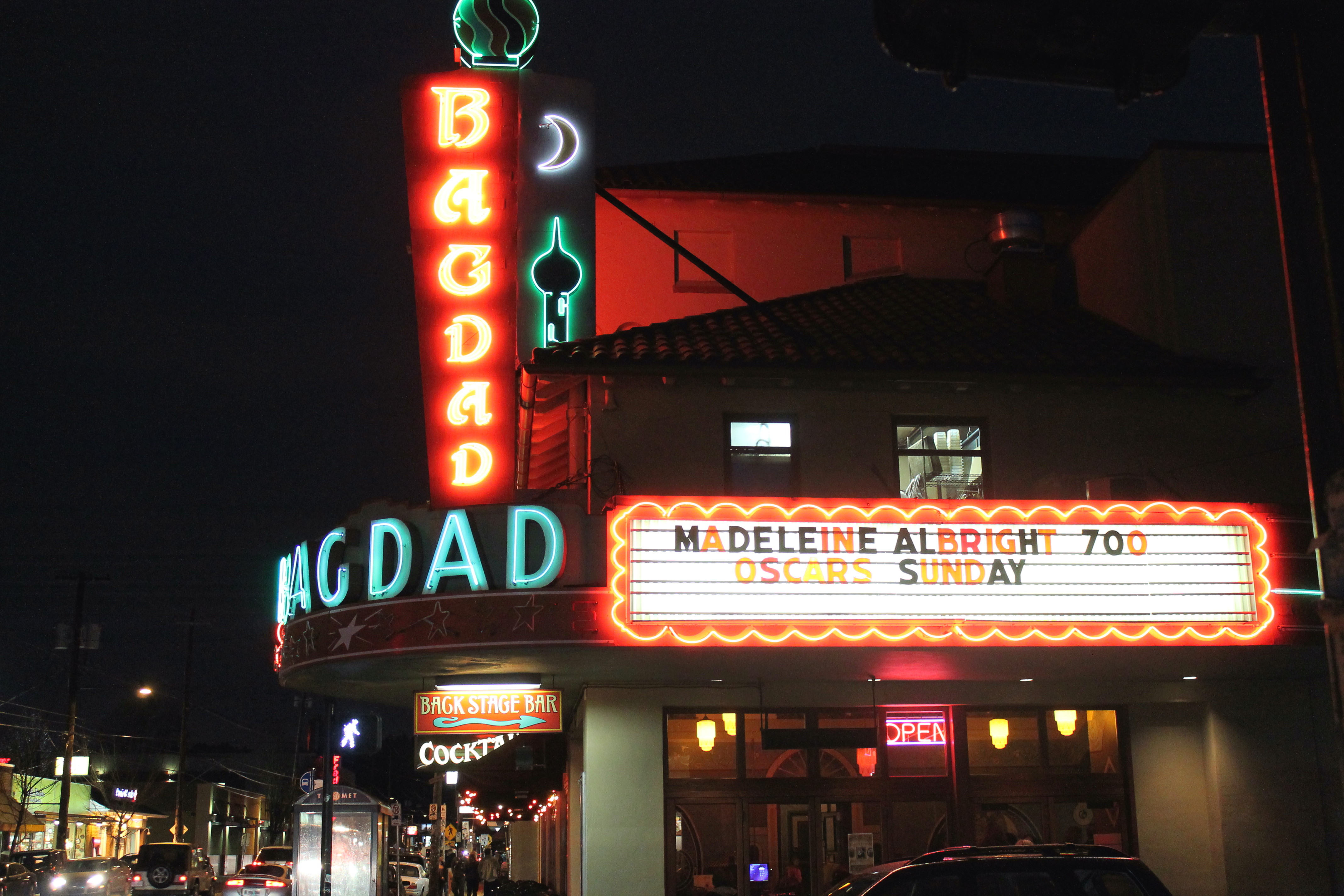
Madeleine Albright “Plays” the Bagdad Theater

IMG_0963

Last night my husband and I went to see former Secretary of State Madeleine Albright speak at the historic Bagdad Theater & Pub in Portland. She was in town promoting her fifth book Prague Winter: A Personal Story of Remembrance and War, 1937-1948, which was released in paperback earlier this week.

In her introduction of the speaker, Maria Wulff, President of the World Affairs Council of Oregon indicated that Secretary Albright had twice before spoken at the Bagdad — in 2002 and 2008. She was happy to be back, as it was “the coolest place she’d ever played.” My husband and I were also happy about the choice of venue. Where else can you sit back with a pint of craft beer and a slice of pizza while listening to a woman who helped paved the way for women in international relations careers?

Luckily, we bought our tickets in early January because the event sold out several weeks ago. Portland is truly an internationally-minded, literary town. We arrived 30 minutes before the “show” and managed to score a pair of seats together in the back row.

IMG_0965

The event was set up as an interview between Secretary Albright and Ms. Wulff, and largely focused on the content of Prague Winter. I haven’t yet read the book, but a copy was included in the price of admission, so I hope to read it and review it soon.

Whereas Albright’s earlier books largely dealt with her career, Prague Winter is about her childhood, in which she acknowledged she wrote because she “needed to find out more about my own family story.”

She was the daughter of a Czech diplomat, born in Prague in 1937, shortly before the onset of World War II. When the Nazis occupied Czechoslovakia, Albright and her family fled to London, and ultimately to the United States. She grew up Roman Catholic, and converted to Episcopalian when she got married. Only when she was 59 years old, shortly before she became Secretary of State to President Bill Clinton, did Albright learn that her family was of Jewish descent. According to Albright, “It’s one thing to find out you’re Jewish, and another to find out so many members in your family died in concentration camps.”

Throughout their conversation, Albright and Wulff weaved the personal and the political/historical. There was much talk about World War II, and Wulff referenced a part of Prague Winter where a high-level Nazi is assassinated as reading “like a thriller.” Wulff asked how Albright’s own history influenced her work in confronting ethnic cleansing in Bosnia in the 1990s. Albright praised the United Nations International Criminal Court for its ability to place guilt individually, rather than collectively, while also questioning whether large, powerful countries had the right to make decisions about smaller countries without their involvement.

Albright expressed her current support of immigration reform. “I know this may sound self-centered,” she said, “but America’s really gained from its immigrants.”

During a brief period of Q&A, where audience members could submit questions in writing, Albright was asked what she though of John Kerry’s appointment as current Secretary of State, and whether she thought Hillary Clinton would run for president in 2016. She was also asked why the United States chose to intervene in Bosnia, but not in Rwanda — a question I am sure she is asked often. Nobody ever asks why the U.S. chose to intervene in Afghanistan and Iraq, but not during the Second Congo War and subsequent Kivu Conflict — although it has been the deadliest war since World War II. Is it because Americans benefit from cheap conflict minerals in their iPhones and MP3 players?

For those who live in the Portland area, Powell’s Books has an interesting upcoming line-up in its Arts, Culture & Sciences book series, including food activist/journalist Michael Pollan at the Newmark Theatre on May 14 to talk about his latest book Cooked: A Natural History of Transformation. The World Affairs Council of Oregon is also hosting the 2013 International Speaker Series this spring, featuring paleoanthropologist/ environmentalist Richard Leakey talking about climate change and the road to human extinction on April 25 and His Holiness The Dalai Lama speaking to what is sure to be a sell-out crowd at the Memorial Coliseum on May 11. Although tickets to these events are much more expensive than the $16 it cost to see Secretary Albright, the International Speaker Series is fortunately now a part of the Arts for All program, making such events accessible to certain low-income individuals.

Posted in Oregon | Tagged , , , | Leave a comment

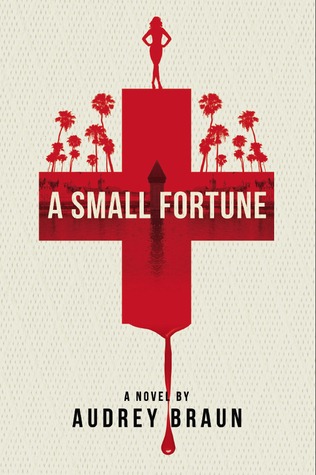
A Small Fortune Book Review

One of the factors that is attractive for me in deciding to read a book is location. If a book takes place in an “exotic” location I’d like to visit, or if it is set in a place I’ve either lived in or visited before, I am more likely to read it. When I learned that A Small Fortune was set in both Mexico and Switzerland, I actually decided to read it because of the setting rather than the plot — although this is a completely plot-driven novel.

A-Small-Fortune

Celia Donnelly is an over-worked copy editor from Portland, Oregon, whose life isn’t all that extraordinary. She appears to be only lukewarm in her marriage to her husband of eighteen years, and has a somewhat strained relationship with her sixteen-year-old son. So when her husband decides to surprise them with a spring break vacation to Mexico, Celia jumps at the opportunity.

But the vacation does not end up being the vacation of Celia’s dreams. Less than 24 hours after their arrival, Celia is kidnapped and locked in a room for reasons she does not understand, yet her kidnappers seem to know everything about her. As the story unfolds, she begins to learn that her life and her history are not at all as she had thought.

I don’t want to give away too many details of this fast-paced thriller, because I don’t want to spoil the story for any potential readers. I will say that this was an enjoyable page turner. I don’t generally read a lot of mystery-type books, because I often find them too predictable, but that was definitely not the case with this book. It is full of drama and surprises.

Sometimes the drama is a little too high, and the storyline is a bit unbelievable, but that didn’t really take away from my enjoyment of the book. I don’t always expect books to be 100 percent realistic. I was a bit bothered a few times that the story jumped ahead without filling in all of the pieces in the protagonist’s chronology, but I imagine author Audrey Braun did this intentionally so as not to bog the story down too much.

If you are looking for a quick, easy read with lots of action and a little bit of romance, then A Small Fortune is an entertaining possibility.

Posted in Around the World Virtual Book Club | Leave a comment

Les Misérables Book Review

When I went to see the play Titus Andronicus at the Utah Shakespeare Festival last year, the auditorium for the pre-play orientation was packed. It wasn’t because patrons had flocked to see the great Shakespearean horror play, however, but a sold out performance of the musical Les Misérables. I’d heard of the latter, but never given much thought to it. Yet when the festival director described it as based on a novel by Victor Hugo — a tale of poverty and injustice — it sounded like something I would like to read. When I learned that it had been made into another movie, I requested the book from my local library. Only then did I learn that it was a 1,200+ page epic tale.

Jacket

At the core of the novel Les Misérables is the character Jean Valjean. Sent to prison for stealing a loaf of bread to feed his sister’s seven starving childen, Valjean tries to escape on several occasions and ends up serving a total of 19 years. Upon his release, he is issued yellow parole papers — a scarlet letter of sorts — condemining him to rejection by almost everyone he encounters. He is finally shown mercy by an old bishop, and the events that unfold during the one night at the bishop’s parish house will change the course of Valjean’s life — for better and for worse.

The book is divided into five volumes, each between 200-300 pages. Throughout the course of the story, we meet other major characters whose paths cross Valjean’s. There is the beautiful yet impoverished Fantine, her illegitimate daughter Cosette, who she entrusts to the unscrupulous opportunist Thénardier, the antangonistic police inspector Javert, the revolutionary-minded and love-struck young Marius.

In its bare essence, Les Misérables is quite a compelling story — a story of injustice, ill-fortune, devotion and love — so great that I devoured it in 11 days. At times the tension was so high, that I felt like I was witness to a soap opera. I couldn’t help but pity Valjean, who despite likely being the most upright character in the story (and perhaps the wealthiest as well), was looked down upon by society and never thought he deserved his happiness. I also found it interesting that the antagonist of the story was a member of the police force — a person who society respected, yet who became obsessed with his quest for vengeance.

There are so many layers of the story, and it is interesting to note that, at the time of its publication in 1862, Les Misérables was already considered a work of historic fiction. The story is set amidst the backdrop of the French Revolution, and as one of the story’s characters remarks in Volume One, the French Revolution was likely the most important event the world had seen since the birth of Christ. On one side, you have “the miserables” — the outcasts, the hungry and the paupers. On the other, you have the “bourgeoisie” — not necessarily the wealthy and upper-middle class as the word commonly denotes, but as Hugo defines, those who are ambivalent to the current political and social order.

The one downside of the book, which I should mention, is the frequent digressions. For example, Hugo’s depiction of the Battle of Waterloo, which begins Volume II, likely took me a longer time to read than the battle took itself. Some of his descriptions, such as setting the stage of the convent that temporarily houses Valjean and Cosette, are interesting in an historical and philosophical sense, yet deviate from the main plot for hours of reading.

I feel that no matter what I write in this review, I cannot do this book justice. This is perhaps the best book I have ever read. If you aren’t turned off by the 1,200+ pages and occasional digressions, then I highly recommend it.

I have still to see the play and/or movie, and I refrained from rushing out to see the movie while it is still in the theatres. I think I learned my lesson with The Hobbit. I need time to continue pondering the book, and I will likely get the movie once its available on Netflix.

To close with a quote from Victor Hugo, which begins Les Misérables:

While through the working of laws and customs there continues to exist a condition of social condemnation which artificially creates a human hell within civilization, and complicates with human fatality a destiny that is divine; while the three great problems of this century, the degradation of man in the proletariat, the subjection of women through hunger, the atrophy of the child by darkness, continue unresolved; while in some regions social asphyxia remains possible; in other words, and in still wider terms, while ignorace and poverty persist on earth, books such as this cannot fail to be of value.

Posted in Book Challenge | Leave a comment