Coming to Ground Film + Connecting with Local Food Systems

I cannot remember exactly when my interest in sustainable and healthy food systems began, but it has grown as a result of reading books like In Defense of Food: An Eater’s Manifesto and watching compelling documentaries such as Food, Inc. I gave up shopping at conventional grocery stores nearly 10 years ago, and even tried to support locally-produced foods as much as possible when living in the desert environment of Las Vegas (some of my old entries on that topic may be found here).

Since moving to Oregon, connecting to a locavore diet has become significantly easier. While I admittedly still regularly shop at Trader Joe’s and other specialty food stores, I do believe it would be entirely possible to live off a diet that has been produced within a 65 mile radius (I use that distance because that is about how far I live from the Pacific Ocean). We even have a diverse range of local wineries, craft breweries and distilleries that are worth bragging about, but I will save that for future posts.

Recently I learned about the Dairy Creek Community Food Web (DCCFW) whose mission is “to promote the local food community in Western Washington County [Oregon] by exchanging knowledge and resources to grow, process, share and celebrate food.” Last night my husband and I attended a special screening of the 2012 documentary film Coming to Ground, that was co-hosted by the DCCFW and the Forest Grove Chapter of Grange.
Coming to Ground

Coming to Ground portrays the Kentucky agricultural industry’s efforts to move away from their dependency on tobacco farming to create a new economy and culture of farming. Benefitting from funds allocated in the 1998 Tobacco Master Settlement Agreement, a new generation of Kentucky farmers invested in alternative types of farming such as vegetables, beef, vineyards and even goat cheese.

What I liked best about the film is that it didn’t demonize the government or the food industry, but rather showed positive large-scale change within the food system that can result from effective citizen advocacy. The film makers were present at last night’s screening, and engaged audience members in discussion after the showing. They talked about how they wanted to show how you do need government to create change within the food system, but that the need for change must also come from the consumers/eaters. For example, the film showed a bustling farmers’ market in Lexington, Kentucky, where local farmers earn back 100% from the sale of their food by selling directly to the consumer, without the use of a middleman.

IMG_0086

I still have a lot to learn about sustainable, local food systems, and a long way to go before I transition my diet to entirely consuming local foods. But I do think it is important that films like Coming to Ground and grassroots food advocacy organizations promote an open dialogue among the eating public to create positive change within our food systems from the ground up.

Posted in Becky's Activism, Green Living, Healthy Living, Movie Reviews/Book Reviews, Oregon, The Simple Living Experiment | Tagged , , , , , | Leave a comment

Criminal Crafts + Macabre Gingerbread People

I first saw the book Criminal Crafts: Outlaw Projects for Scoundrels, Cheats, and Armchair Detectives in the gift shop during my recent visit to the Mob Museum in Las Vegas. I am a huge fan of craft books with off kilter DIY projects, so I was pleased to learn that my local library had 3 copies of the book.

Jacket

Criminal Crafts has 30 projects inspired by notorious criminals, heinous crimes or morbid activities. The book is divided into four sections: practical projects, fashion/accessories, recipes, and home décor. Among the projects to choose from are Voodoo Doll Pincushion, John Dillinger Soap Gun, Dia de los Muertos Bath Fizzies, and Crime Scene Carpet.

One of the things I liked best about the book is that many of the projects make use of recycled and repurposed objects such as brown paper grocery bags, seat belts, and old, unloved socks. There are several fun cocktail recipes — including an atomic bomb-inspired drink that dissolves into a mushroom cloud and a Bloody Mary-type drink that involves a beef jerky voodoo doll being set on fire — that I think would be really great additions to parties. The Barefoot Bandit Grass-Head Cellmate would be a great project for kids (and cats).

My husband and I decided to try out the recipe for Crime Scene Gingerbread Men. As the picture from the book shows below, there are a lot of fun things you can do with gingerbread people — tie a noose around their necks with licorice rope, run them over with Hot Wheels, stab them with cocktail swords, or knock them out with a sugar cube.

IMG_0944

The gingerbread recipe featured in the book is a rather tasty adult version which includes 2 tablespoons of rum and isn’t overly sweet. Since it was already 10 days past Christmas we had a hard time finding gingerbread cookie cutters in local stores. Finally, we settled on a large gingerbread man cut-out on clearance at Joann Fabrics. While Criminal Crafts indicates the recipe will yield about 3 dozen gingerbread men, we ended up with a baker’s dozen of gingerbread giants. Or monsters.

IMG_0937

We also had a hard time finding the recommended embellishments. Who knew licorice rope is so scarce? Finally, we decided to buy a 4-pack of food coloring to embellish our people with decorative icing. I will say the icing recipe in the book turned out gross. We made our own icing with 1 cup powdered sugar, 1/2 stick of butter and about 1 tablespoon of milk.

To warn you, sometimes my husband and I have a twisted sense of humor. The following image is for mature adults only. Here is my husband’s favorite creation:

IMG_0942

I chose to go with a literary theme. After all, Frankenstein’s monster was a murderer.

IMG_0943

Posted in DIY, Movie Reviews/Book Reviews, Recipes | Tagged , , , , , , , | Leave a comment

The Round House

In November 2012 Louise Erdrich’s novel The Round House was awarded the National Book Award for Fiction, beating out a rather competitive field. This was the 14th novel from this award-winning Native American author. I hadn’t previously read any of her work, but after reading the short synopsis of her latest work, I was greatly intrigued.

Jacket

The Round House is told from the point of view of 13-year-old Joe Coutz, who lives on an Ojibwe (Anishinabe) reservation in North Dakota with his parents, a tribal judge and a tribal enrollment/census officer. The story begins on a seemingly normal Sunday afternoon in late spring, and Joe’s mom, Geraldine, has gone down to her office to retrieve an important file. When she does not return home within a reasonable amount of time, Joe and his father begin to worry. They go out looking for her, eventually seeing her driving back home at record speed. Back at the house, Geraldine seems unable to leave her car. They discover her severely beaten and faintly smelling of gasoline, and immediately rush her to the local hospital.

In the weeks following her brutal attack, rape and attempted murder, Geraldine is naturally withdrawn from those around her, rarely leaving her bedroom. Her attacker is still out there, and a certain fear prevents her from disclosing the details of the attack, including the identity of the perpetrator. Taking justice into his own hands, young Joe seeks to uncover details of the crime and restore his family to the before-time.

In a beautifully written story, Louise Erdrich blends together Native American history, spirituality, and tribal vs. federal law. It is not coincidental that Joe’s father is an attorney and tribal judge, and numerous court cases are brought up throughout the course of the story — both in regards to tribal sovereignty and the federal government of the United States. Interspersed within Joe’s tale — and perhaps in attempt to bring some comic relief to a rather tough story line — are the obsessions of a typical 13-year-old boy, such as breasts and Star Trek: The Next Generation.

In the afterword to The Round House (page 319), Erdrich writes that “1 in 3 Native women will be raped in her lifetime (and that figure is certainly higher as Native women often do not report rape); 86 percent of rapes and sexual assaults upon Native women are perpetrated by non-Native men; few are prosecuted.”

I applaud Erdrich for highlighting such an important issue is her art, and the National Book Foundation for giving the book an even wider audience.

Posted in Movie Reviews/Book Reviews | Tagged , , , , , , , | Leave a comment

Le Divorce

While I was in Las Vegas for Christmas, my father gave me a paperback copy of the novel Le Divorce, which he had just finished reading. He said the main character–a young woman who has recently relocated from California to Paris– reminded him a bit of me. My sister wondered why our dad was reading chick-lit, because the book was later turned into a movie starring Kate Hudson.

Jacket

Central to the story of this 1997 novel is the narrator/protagonist Isabel Walker, an early-twenty-something who has recently dropped out of film school at USC. Without anything else on her agenda, Isabel travels to Paris to help her older step-sister, Roxy, prepare for the birth of her second child. However, when Isabel arrives, she learns that Roxy’s French husband has just left her for a Czech woman. As the story unfolds, a pending divorce is in the works, which involves complicated French property laws, including what to do with a potentially expensive painting. Meanwhile, Isabel learns to adapt to a new culture, obtaining a handful of odd jobs through the local American expat community and entering into a love affair with a man old enough to be her grandfather.

At first I had a hard time liking Isabel. She seemed too privileged, immature and ignorant of her surroundings. But around page 100, my attitude changed, and I could relate with her character quite a bit. Isabel is a true “live in moment” type of person, soaking up her current surroundings while not giving much thought to future plans. This paves the way for her flexibility to follow new adventures that may pop up, such as moving to France in the first place, and then contemplating a move to Sarajevo to volunteer with a charitable organization. She also likes to read and reference classic books, such as the writings of Jean-Paul Sartre and Ernest Hemingway, to give the impression that she really is smart.

Author Diane Johnson does such a good job of portraying the mindset of a woman in her early twenties, that I was surprised to learn that she was in her sixties when she wrote the book. Despite much of the book being about the fate of the above-mentioned painting and love affair, and the book being more character-driven than plot-driven, there are a few suspenseful plot twists. Overall, the book is written in a light, comic style, with a plethora of social commentary worked in — especially the differences between the cultures and viewpoints of French nationals and American expats, despite however hard the American expats try to fit in with their new society.

Posted in Around the World Virtual Book Club, Movie Reviews/Book Reviews | Tagged , , , , , | 1 Comment

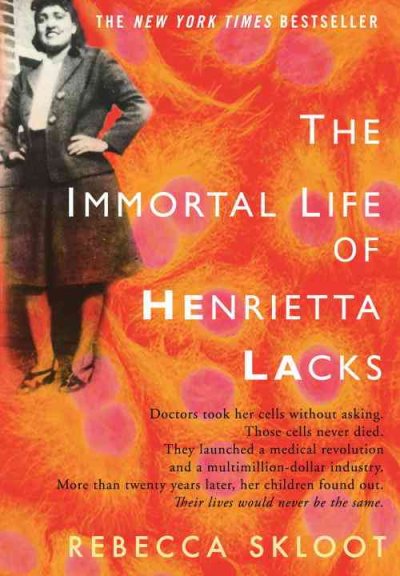
The Immortal Life of Henrietta Lacks

Of the 40+ books I read in 2012, The Immortal Life of Henrietta Lacks has probably been my favorite.

Jacket

In the 1950s doctors took cells from a thirty-one year old African-American woman dying from cervical cancer, without her consent or her family’s knowledge. The cells and their offspring would go on to revolutionize science and the medical industry for decades to come, creating a multi-million dollar industry along the way (none of which Henrietta’s family benefited from).

Henrietta’s cells, known in the scientific world as “HeLa,” have likely impacted the lives of nearly every person on earth. They were used in the development of the polio vaccine, turning the disease from a devastating epidemic to one that has nearly been eradicated in roughly a 50 year period. HeLa cells have also led to many important cancer-related studies, such as linking the virus HPV to cervical cancer, and later developing the HPV vaccine.

The Immortal Life of Henrietta Lacks is part biography of Henrietta’s short life and how the eventual knowledge of her immortal cells has shaped the lives of her surviving family members. The book also details the history of the immortal cells, how they have shaped medical research over the years, and raises many important issues in the field of biomedical ethics.

What I liked best about the book was the story of Henrietta’s surviving family members. Her only surviving daughter, Deborah, became quite close to author Rebecca Skloot during the course of research for the book, and took immense pride in her mother’s legacy, trying to learn as much about science as she could even though she only had a middle school education. Rebecca was first intimidated when she met Henrietta’s youngest son, Zakariyya, who had been in and out of prison and dealt with tremendous anger management issues. From the moment of conception, Zakariyya’s life had been impacted by Henrietta’s cancer cells — from being inside her womb alongside the growing cancer, to growing up without a mother, to feeling the weight of injustice of the use of the immortal cells.

Perhaps the greatest injustice of all is that most of Henrietta’s surviving family members lived in poverty and couldn’t even afford health care themselves, yet others have become rich and famous thanks to Henrietta’s cells. I wonder if the story would have been different had Henrietta been white, or from a middle-class family. It also makes you wonder what comes first in the minds of many scientists and medical professionals — people or profit.

Posted in Book Challenge | Tagged , , , , , | Leave a comment