The Art of Non-Conformity

In his 2010 book The Art of Non-Conformity: Set Your Own Rules, Live the Life You Want, and Change the World, Chris Guillebeau expands upon the ideas in his popular blog and online manifesto, A Brief Guide to World Domination.
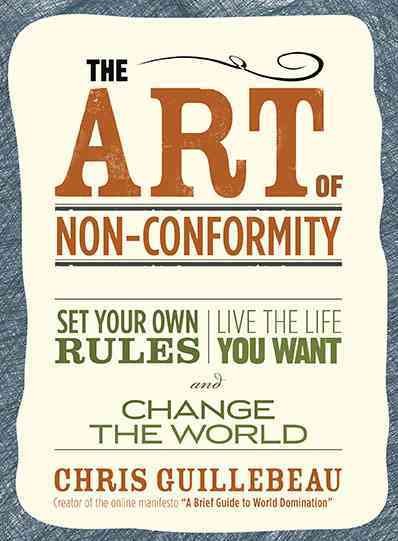
The book begins with a description of what Guillebeau calls ‘sleepwalkers,’ which he defines as people leading lives that are ‘unremarkably average.’ In the following pages of this quick read, Guillebeau frequently cites his own successes (and a few successes of others) as he describes the path of self-employment, setting and achieving goals, and living a life according to one’s dreams and values.

I will admit that I chose to read this book largely because of the catchy title, and because it had been described on a few other blogs as a must read. I haven’t followed Guillebeau’s blog in the past, so I hadn’t previously been exposed to his philosophy. However, in my recent first visit to his website, it appears that he has quite a cult following with hundreds of comments on his blog posts and through an annual World Domination Summit that attracts thousands of attendees. Clearly Guillebeau’s ideas are popular, and many people crave to lead a life according to his example.

He has achieved a lot of the goals which he has outlined in his book. He has created a small army of committed followers, he has published several best-selling books, and perhaps most notably, he has almost achieved his goal of visiting every country in the world by his 35th birthday. At the time of writing this post, Guillebeau has visited 189/193 countries with an April 2013 deadline. Clearly there is much to be proud of.

On paper, I have a lot in common with Chris Guillebeau. We are roughly the same age, live in the same city, are both self-employed, have master’s degrees in international development-related fields, and have both volunteered for several years in Africa. I have even adopted a number of the philosophies he posits in this book, such as radical exclusion, debt free living and making the most of airline frequent flyer programs. One would think I’d love this book, but unfortunately I didn’t.

I had a hard time with the tone of voice. While this may be a good read for someone who is looking to make radical changes to his/her life and is looking for a pep talk, this book isn’t for everyone. I respect that, but I am not sure that Guillebeau does. Many people do find happiness in life by following traditional paths. While entrepreneurialism may be the best road for some, and may especially seem like an alluring path in times of economic hardship, there’s growing discussion that only a handful of the population is fit to succeed in self-employment.

Overly idealistic people oftentimes glorify self-employment, without acknowleding ongoing challenges such as inconsistent income, the constant need to build clients and negotiate new contracts, and the reality that self-employed individuals are taxed more heavily than those in traditional employment, without getting benefits such as health insurance, paid vacations and retirement bonuses. When I am tracking down late payments and working twice as many hours as I get paid for, I often remember the days when I could rely on a paycheck at the end of each month and I would get paid for a certain number of hours even though I might not have been actively working much of that time.

I also struggled with Guillebeau’s opinions on university education, which he describes as a waste of time and money, and resulting in nothing more than a piece of paper. Perhaps I was blessed to attend a liberal arts college for my undergraduate education that was focused as much on the out-of-classroom experience as the coursework itself, but I do not share his views. I do agree that education is an expensive investment, and while I have yet to see a return on investment in the monetary sense, I have already reached my experiential investment every time I visit an art museum, discuss archaeology at parties, or write a research paper that has the potential to positively affect public policy I believe in.


Posted in Book Challenge | Tagged , , , , | 5 Comments

A Black Friday Deal for Book Lovers

Generally I am not a fan of blatant advertising on my blog. I am not even really a fan of Black Friday. My husband and I are planning to avoid all malls and major shopping centers, and we’re hoping to hit up some Washington County Winery Opening Houses instead. However, I discovered this Black Friday deal that is too good not to share.

Recently Powell’s Books and other indie bookstores have begun to sell Kobo eReaders as an alternative to the Kindle and the Nook. There’s the Kobo Glo eReader, which retails for $129.99 and is comparable in features to the Kindle Paperwhite and Nook Simple Touch. My personal favorite, however, is the Kobo Mini eReader, which markets itself as the world’s smallest full-featured eReader. The Mini is also much friendlier on the wallet, with a standard retail price of $79.99. But on November 23 & 24 only, it will sell for only $49.99.

The actual size of the Kobo Mini is much larger than pictured.

The Kobo Mini eReader has a 5″ glare-free E ink touchscreen, 2 GB of storage, built-in WiFi and is compatible with EPUB, PDF, JPEG, GIF, PNG, TIFF, TXT, HTML, RFT, CBZ, and CBR file types. Kobo eReaders have instant access to nearly 3 million eBooks, including nearly a million titles that are completely free to download.

As I am a member of the Powell’s Partner Program, if you do decide to take advantage of this promotion, I’d appreciate it if you click on the link below.

Disclaimer: Kobo Mini and Kobo logo are trademarks of Kobo, Inc. Although I am a member of the Powell’s Books Partner Program, all views expressed on this blog are my own.

Posted in Book Challenge, Movie Reviews/Book Reviews | Tagged , , , , , , | Leave a comment

Manufacturing Consent

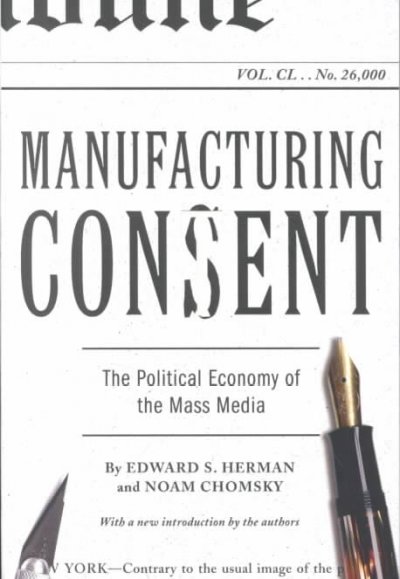
In Edward S. Herman and Noam Chomsky’s 1988 book Manufacturing Consent: The Political Economy of the Mass Media, the authors sketch out a “propaganda model” that has overwhelmed the mass media of the United States, whereby “the media serve, and propagandize on behalf of, the powerful societal interests that control and finance them” (Introduction to the 1992 Pantheon Books edition, p. xi).

Their hypothesis is examined through 5 filters:

  1. The size, ownership and profit orientation of mass media conglomerates (which have been further consolidated and formed even larger monopolies since this book was published);
  2. The advertising license to do business, whereby mass media is heavily subsidized by advertising/corporate revenue, which in turn shapes the media’s messaging;
  3. Sourcing of news from a handful of sources where news might break, because reporters and cameras cannot be at too many places at once;
  4. Flak, which refers to negative responses to the media, and therefore must be controlled; and
  5. Anti-Communism as a control mechanism.

These filters are further explored through a number of case studies from events in the 1970s and 1980s, including elections in several Central American countries; the KGB-Bulgarian Connection in the plot to assassinate Pope John Paul II in 1981; and the Indochina Wars in Vietnam, Laos and Cambodia.

Because this book is nearly 25 years old, and its examples even older, these events either happened before I was born or in my very early childhood. For me, this book read more like a history book. Until recently, I knew very little of the Sandinistas in Central America and Pol Pot in Cambodia, although I have recently been inspired to add The Killing Fields to my Netflix queue and the newly released In the Shadow of the Banyan to my reading list.

Herman and Chomsky talk about worthy vs. unworthy victims, whereby “a propaganda system will consistenly portray people abused in enemy states as worthy victims, whereas those treated with equal or greater severity by its own government or clients will be unworthy” (p. 37). For example, the U.S. mass media heavily covered the murder of a Polish priest in 1984, who was perceived as a “worthy victim,” but barely mentioned the assassination of Archbishop Oscar Romero in 1980 because what he stood for wasn’t consistent with U.S. policy.

I wonder, if the case studies were updated to reflect news from the past decade, which stories would be cited? I am frequently appalled by how much our media loves to discuss the latest sex scandals and tragic deaths of beautiful women, but ignores genocide in the Democratic Republic of the Congo. In recent years, I’ve almost completely avoided broadcast media, because I detest the way many newscasters rehash the same stories and viewpoints over and over again. I prefer to obtain my news from a variety of print sources, subscribing to The Economist, reading The Christian Science Monitor and The Huffington Post online, and scanning the latest headlines on MSNBC.com and Twitter.

I also wonder how the rise of citizen journalism, the blogosphere and social media as news sources have either contributed to or challenged the propaganda model. According to a 2008 interview with Chomsky, access to information is not enough, if one lacks a framework for understanding it.

Because both Herman and Chomsky are academics, this is a textbook-like read. For those interested in the concepts presented in the book, but not up for the challenge of reading it, the 1992 film Manufacturing Consent: Noam Chomsky and the Media addresses many of these same case studies. Interestingly, the film was produced in Canada, which further shows just how unpopular Chomsky’s ideas are in the United States.

Posted in Book Challenge, Movie Reviews/Book Reviews | Tagged , , , , | Leave a comment

Telling My Story

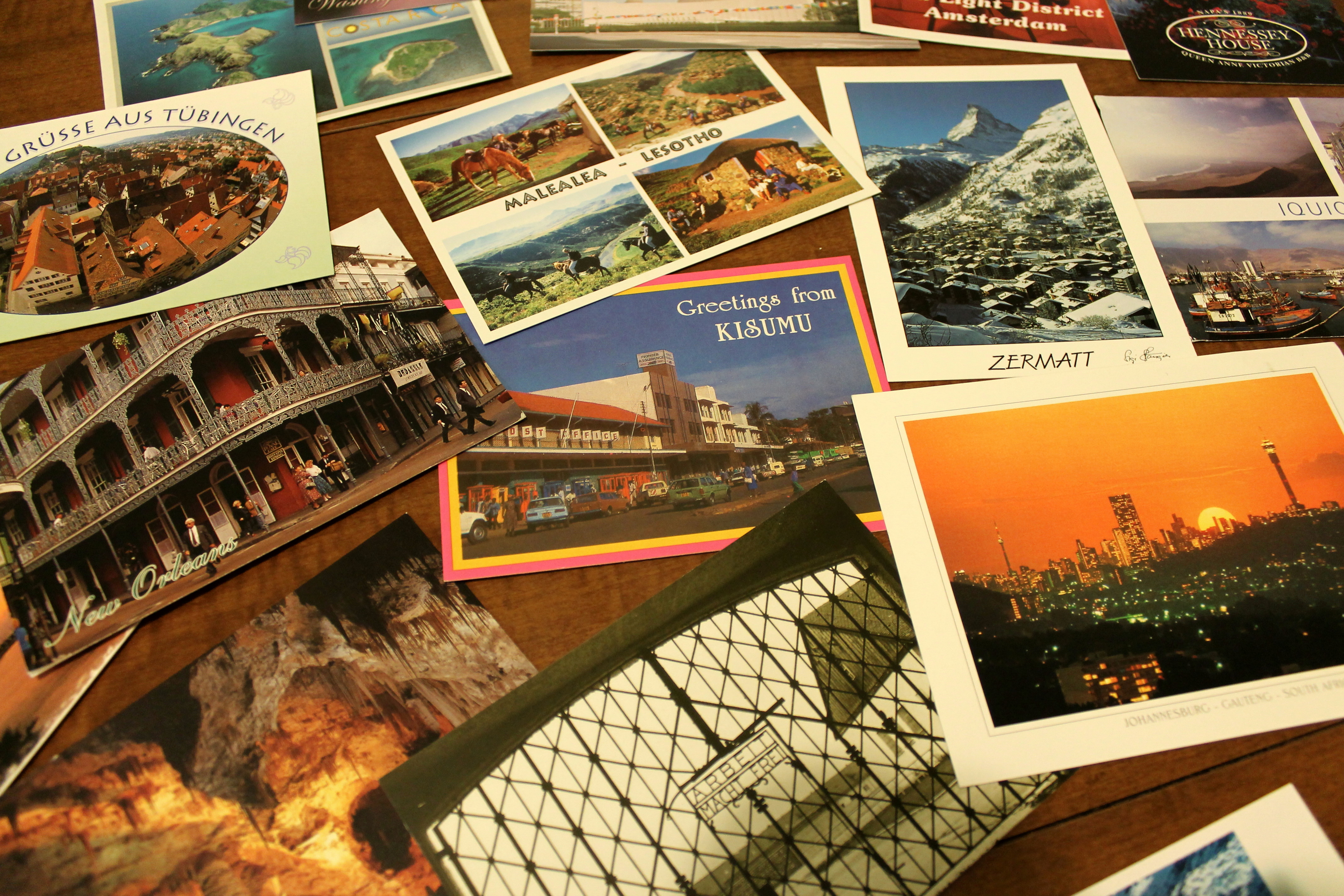
The story of my life may be told in the places I’ve been. A summer spent in Chile working at several archaeology sites. The home in Kisumu, Kenya that welcomed me as a guest for 10 weeks during my graduate school internship. The village of Zermatt, Switzerland, where I spent an Easter weekend by myself after undergoing a difficult break-up and learned to snowboard on the Matterhorn. The bay that separates mainland Costa Rica from Bolaños Islands, where my husband I almost died while kayaking post-hurricane on our 1 week wedding anniversary.

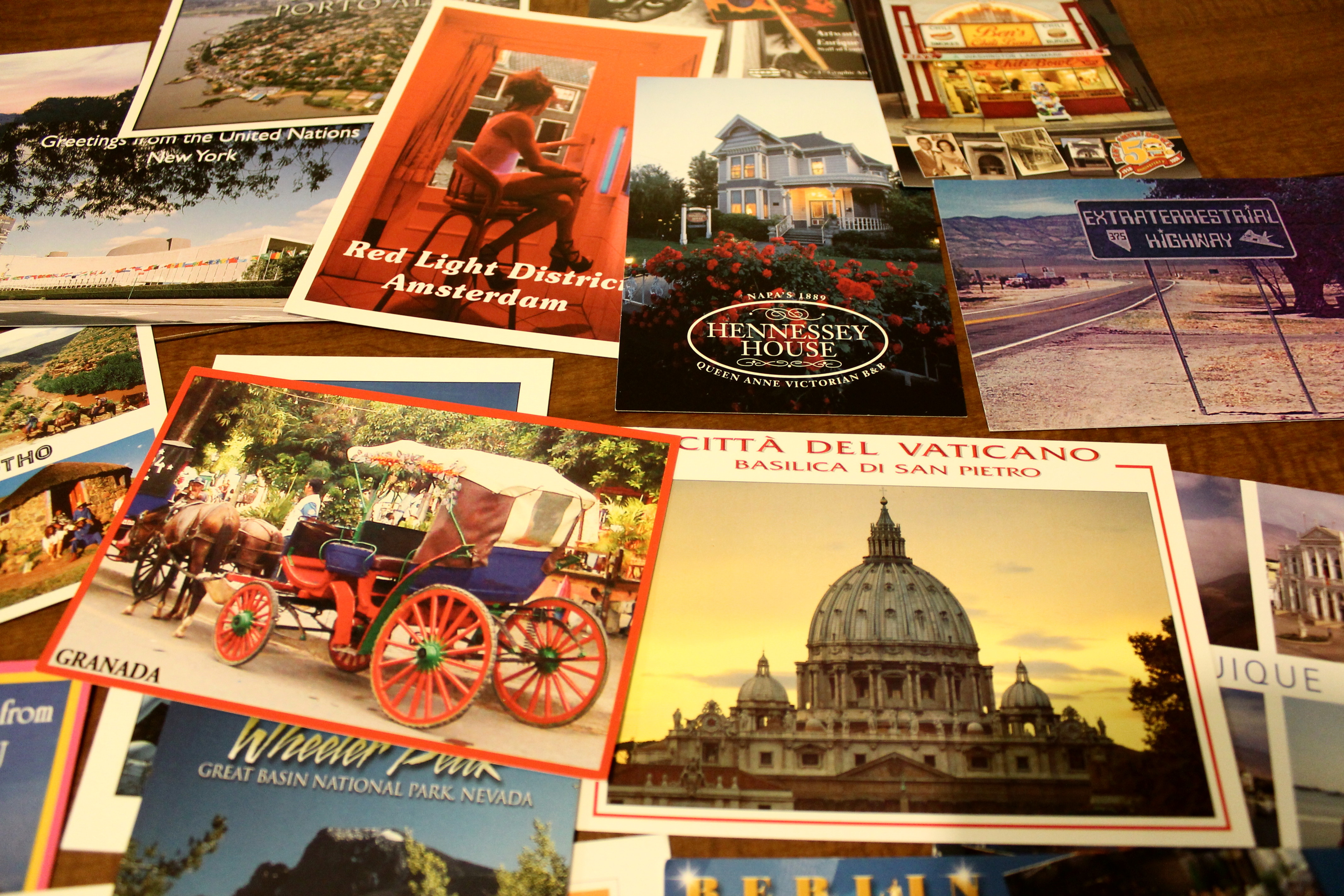
Over the past 15 years I’ve collected postcards from all of the places I’ve been. They’re small, inexpensive souvenirs, and every time I pull them out from my dresser drawers to look at them they trigger memories of the places I’ve been. I am not a materialistic person, but I am attached to memories. Perhaps one of my biggest fears is forgetting.

Recently I decided to write some of those memories down on the backs of the 155 postcards I’ve collected over the years. I consider it part autobiography, part mixed media artwork, part fulfillment of an obsessive-compulsive urge. It’s a work in progress.

How would you tell your story?

Posted in Introspection | Tagged , , , , | 1 Comment

Portland Opera’s Don Giovanni

Earlier this year, my dad took me to several encore showings of the Metropolitan Opera in High Definition at a local movie theater. We saw Verdi’s Ernani and Masseneti’s Manon. I was surprised how much I liked it — the elaborate sets, the beautiful costumes, the magnificent drama.

This past summer, when my husband and I watched all of the Academy Award Winners for Best Picture since 1979, we saw the movie Amadeus. Although he is definitely not an opera fan, he expressed an interest in seeing one of Mozart’s operas. Naturally, I held him accountable. When I learned that the Portland Opera was performing Mozart’s 1787 opera Don Giovanni as their 2012-2013 season opener, I quickly snatched up two tickets before he could change his mind.

This two-act opera is considered by many to be one of the greatest operas of all time. It is part comedy, part tragedy, with an anti-hero in the leading role. Don Giovanni is a serial womanizer. His servant, Leporello, keeps a list of all the women Don Giovanni has seduced, which currently totals 2,065 (yes, there’s even a song in the opera about that). In the opening scene, a masked Giovanni seduces Donna Anna. When he refuses to remove his mask, she cries to her father for help. Her father, the Commendatore, challenges Giovanni to a duel and Giovanni kills him.

Donna Anna and her fiancé Don Ottavio vow vengeance to the Commendatore’s killer. Don Giovanni goes on to seduce other women, introducing a further cast of characters, while vengeance is sought. In the end, the Commendatore returns from the grave to drag an unrepentant Don Giovanni to hell. The moral of the story, sung in the final scene is “Such is the end of the evildoer: the death of a sinner always reflects his life.”

This is the first live opera that I’ve attended in person, so I was incredibly excited to attend to begin with and wasn’t disappointed. I was surprised by how young the cast appeared to be, but I thought they did a fine job, although at times it was a bit challenging to tell a few of them a part (for example, all of the female leads were petite brunettes). Mozart’s score was fantastic, and while the libretto was in Italian, the English translations were projected on a screen above the stage. I had a bit of a hard time shifting my focus from stage to screen, so I am sure I missed a bit of the dialogue, but I could follow the storyline from the performers’ dramatics.

I also thought the art direction was spectacular. Although the set was fairly sparse compared to what you’d find at the Metropolitan Opera, it was versatile and worked well with the choreography. I loved how the lighting made use of shadows, and a large cross was illuminated on stage a various times throughout the performance.

The Portland Opera has 6 levels of seating, making their performances accessible to a wide variety of budgets. We quickly learned that the online tickets from Ticketmaster had obscene service charges and there’s also a surcharge of $6 per ticket for tickets purchased over the phone. We opted to save money and by our tickets at the Portland Opera box office on SE Caruthers, and only paid a $1 surcharge for our $45 tickets. We sat on the far right of the orchestra section, 20 rows from the stage, and had a fairly decent view. However, I do wish I had remembered to bring my small binoculars with me.

We also opted for an early dinner at the Keller Auditorium’s café. They featured a special buffet menu with seasonal, local ingredients for $22 per person, and everything we sampled was delicious. I especially loved the cheese tortellini with roasted garlic nage and winter squash garnish. They also have a selection of martinis and wines by the glass, including wine and spirits produced in Oregon.

Posted in Oregon | Tagged , , , | Leave a comment