The Lovers Virtual Book Discussion

The Lovers by Vendela Vida. Published in 2010.

Synopsis: Recently widowed, Yvonne returns to the coastal village in Turkey where she and her husband honeymooned twenty-eight years ago. The week she had set aside for vacation doesn’t go quite as expected. Once in Turkey, she comes face-to-face with her aloneness, and discovers an unlikely cast of friends – including the wife of her landlord and a young boy who sells shells at the beach. When unexpected tragedy strikes, Yvonne finds herself evermore entagled in a foreign culture that increasingly doesn’t know what to make of her solitary travels.

About the Author: Vendela Vida is the author of 2 fiction books – Let the Northern Lights Erase Your Name and And Now You Can Go – and 2 nonfiction books – The Believer Book of Writers Talking to Writers and Girls on the Verge. She is a graduate of Columbia University’s MFA program in Creative Writing. She lives in the San Francisco Bay Area with her husband (author Dave Eggers) and children.

My Initial Reactions to this Book

Normally, when I’m reading a novel (or any book for that matter), I divide my reading sessions into chapters, reading one or a few in each sitting. This couldn’t be done with this novel, as there are no chapters and it reads like one long story. However, once I got about 10 pages in I didn’t mind this format at all. The novels is that good, and can easily be read in a single sitting.

I was first introduced to Vendela Vida when I was on the Elle Magazine Reader’s Prize Fiction Jury. Let the Northern Lights Erase Your Name was the best novel I read that year (2007). That novel was set in Finland, and not only was it a story about a young woman’s search for her true identity, it was a partial exploration of Sami life in northern Finland.

I was excited when I learned that The Lovers was set in Turkey. I thought, “great! another new place to explore!” I think that’s what I love best about Vida’s writing, that it is anthropological and entertaining at the same time. I have never been to Turkey, but clearly Vida did her homework in capturing the essence of being there.

Central to the book is Yvonne’s experience of being an American woman, a widow travelling alone, in a country that questions her solitariness. I am reminded of how many cultures shun widows and believe their bad luck in bringing about death to be contagious. This is evident in the maid running away at the site of an owl (a bad omen) burrowing in Yvonne’s rented home, and how she was shunned after Ahmet’s death.

I was also touched by the true warmness and friendship Yvonne experienced during her travels in Turkey – the openness that Ozlem shared with both Yvonne and her daughter, the friendship that Ahmet enjoyed despite language barriers, her relationship with Aylin at the end of the book, and even Deniz inviting her onboard her boat for a glass of iced tea during her ocean swim.

Throughout my international travels (many of them solitary), I have also been unexpectedly surprised by the generosity and friendship of people’s invitations and desire to share with a foreigner. Most Americans, it seems, tend to be the opposite – shunning anyone who is different from them. How many people do we encounter for just a short period of time during the course of our lives, who ultimately end up having a profound impact on its outcome?

Have you read The Lovers, and if so, what did you think of the book? Have you read any of Vendela Vida’s other books? Please share your opinion in the comments section below.

Next up for discussion will be Elizabeth Strout’s Pulitzer Prize-winning novel Olive Kitteridge. Discussion begins April 7th.
Posted in Around the World Virtual Book Club, Movie Reviews/Book Reviews | Tagged , , , , , , , | Leave a comment

Hunger Awareness Challenge: Post-Challenge Reflections

Last week I wrote about my attempt to spend a week living off the equivalent average food budget of a Haitian. To recap: with some fancy math, this works out to be $34.33 because our cost-of-living is so much higher. I promised to report back this week on my post-challenge reflections, share some low-cost recipes, and talk about why I think this challenge is timely in light of what is currently going on in our world.

Well, I did succeed in spending no more than $34.42 on food in the last week. From last week’s grocery purchase, I still have half a bag of spinach, 4 eggs and most of a can of cooking spray leftover. I managed to go an entire week without alcohol, which is a major feat for me. But, I must admit, that I did drink some of my husband’s coffee (which he bought on his $34.33 budget, as he’s doing the challenge too), drizzle some olive oil and balsamic vinegar we already had on hand on my salads, and consume 1/3 a loaf of bread with a light butter spread – using the excuse that I didn’t want it to go to waste.

So is this cheating or a revelation in human nature and our impulse to survive? While on the food challenge, I was even more aware of the abundance that most Americans take for granted. With just a budget of $34.33, my instincts were to eliminate extras like prepared salad dressing, chocolate, and wine that are normally a part of my diet, and maximize my resources in order to survive. But when other food items were already readily available – coffee, bread, butter – and I was hungry, how could I resist?

The biggest lesson learned from food challenge? It wasn’t so bad for a week, and I actually ate pretty healthy. But the real challenge would be to live off the budget long-term. Also, this was the average food budget of a Haitian, so what about people who live off even less than this? I also wanted to keep hunger in the United States in mind, and with our food prices growing each day, how does a minimum wage-earning single mom with kids survive and still manage to eat healthy?

While on the hunger, challenge here is pretty much what I ate everyday:

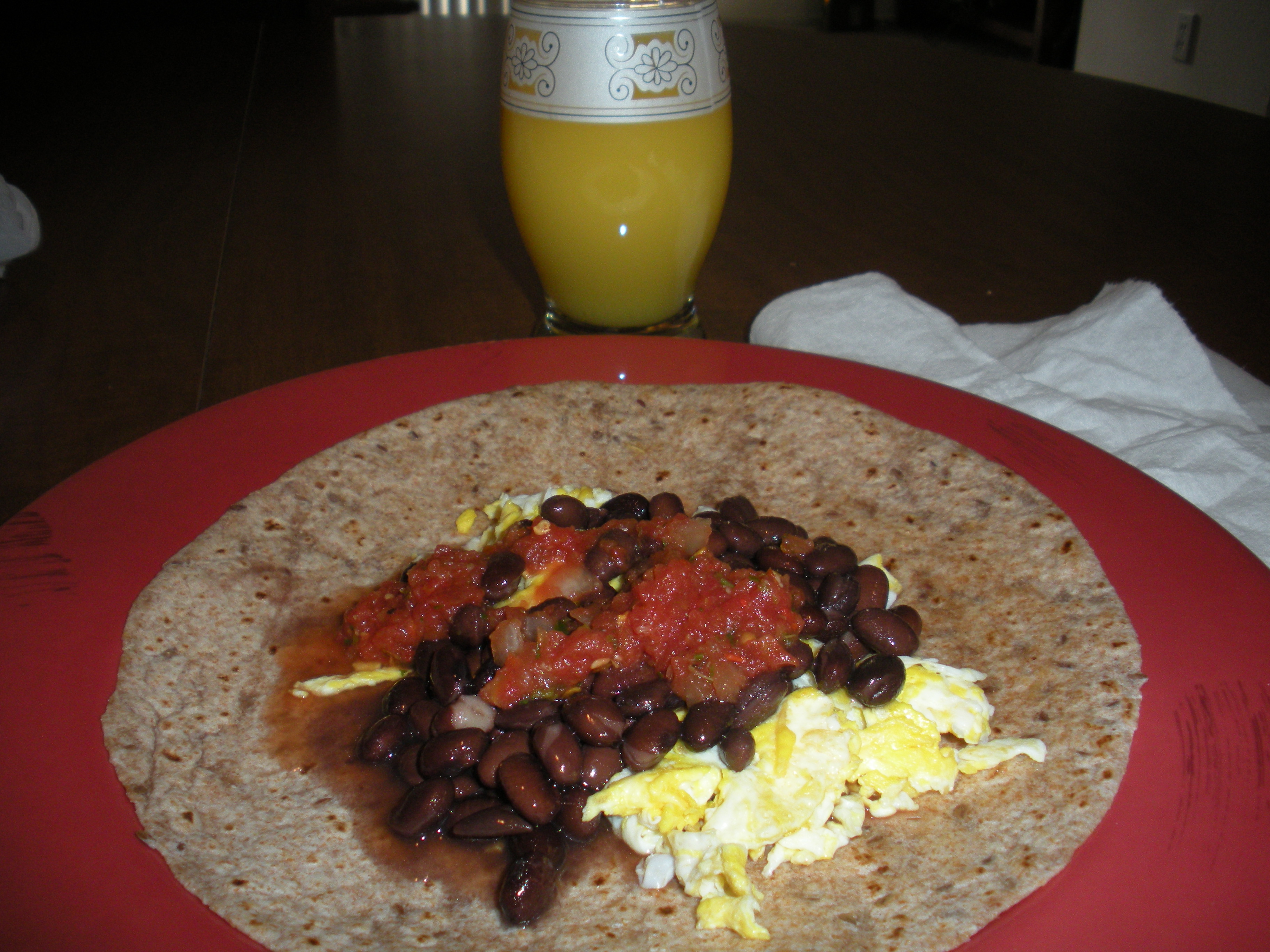
Breakfast:

  • 1 whole grain tortilla with ground flaxseeds
  • 1 cage-free egg, scrambled in a little bit of cooking oil
  • 1/3 can of black beans
  • 1 tablespoon of salsa
  • 1 small glass of orange juice

Estimated Cost per Meal = $1.20

Lunch:

Lunch
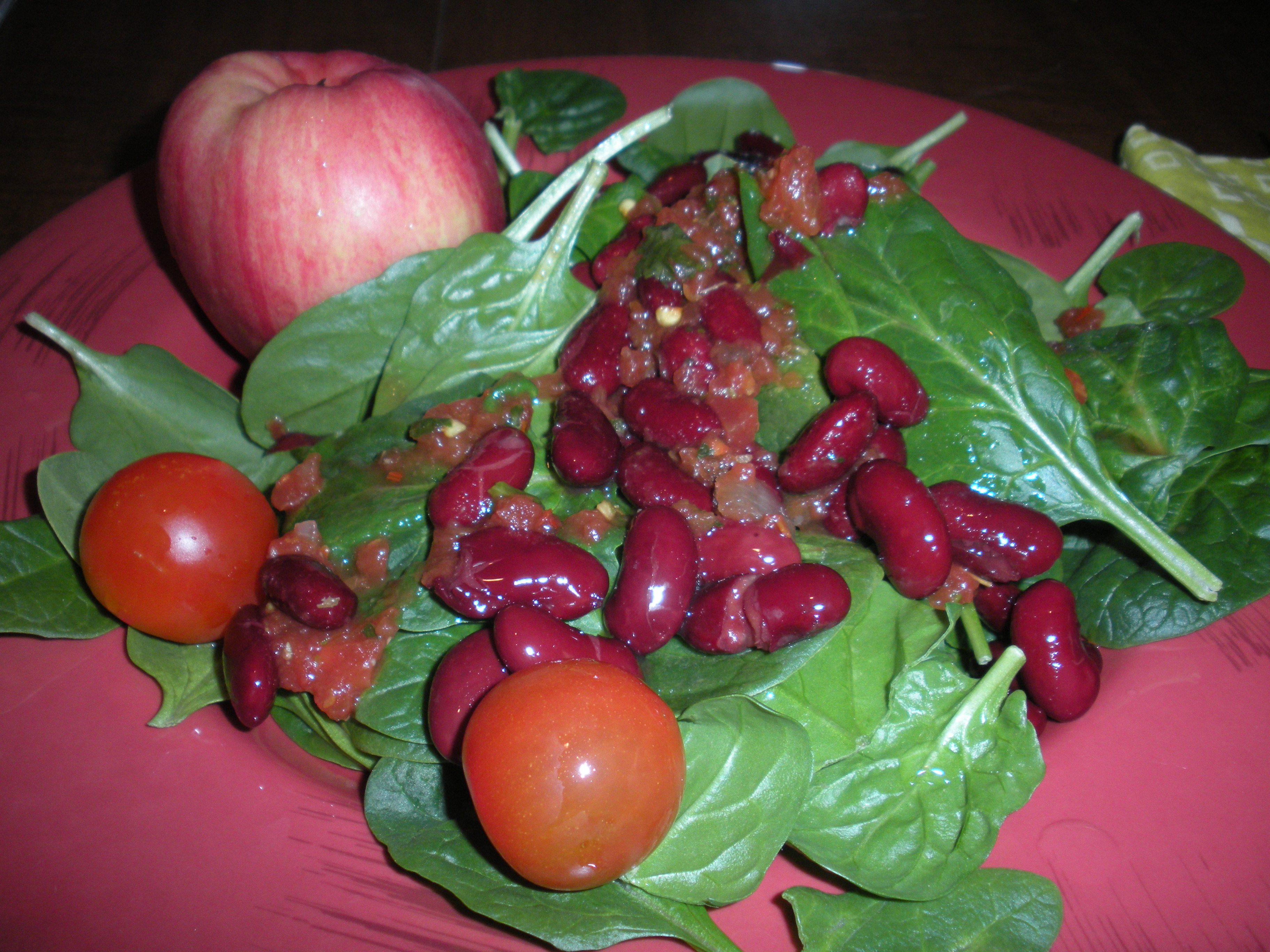
  • 2 cups of organic spinach
  • 5 organic cherry tomatoes
  • 1/3 can of organic kidney beans
  • 1 tablespoon of salsa
  • 1 organic apple

Estimated Cost of Meal = $1.85

Dinner:

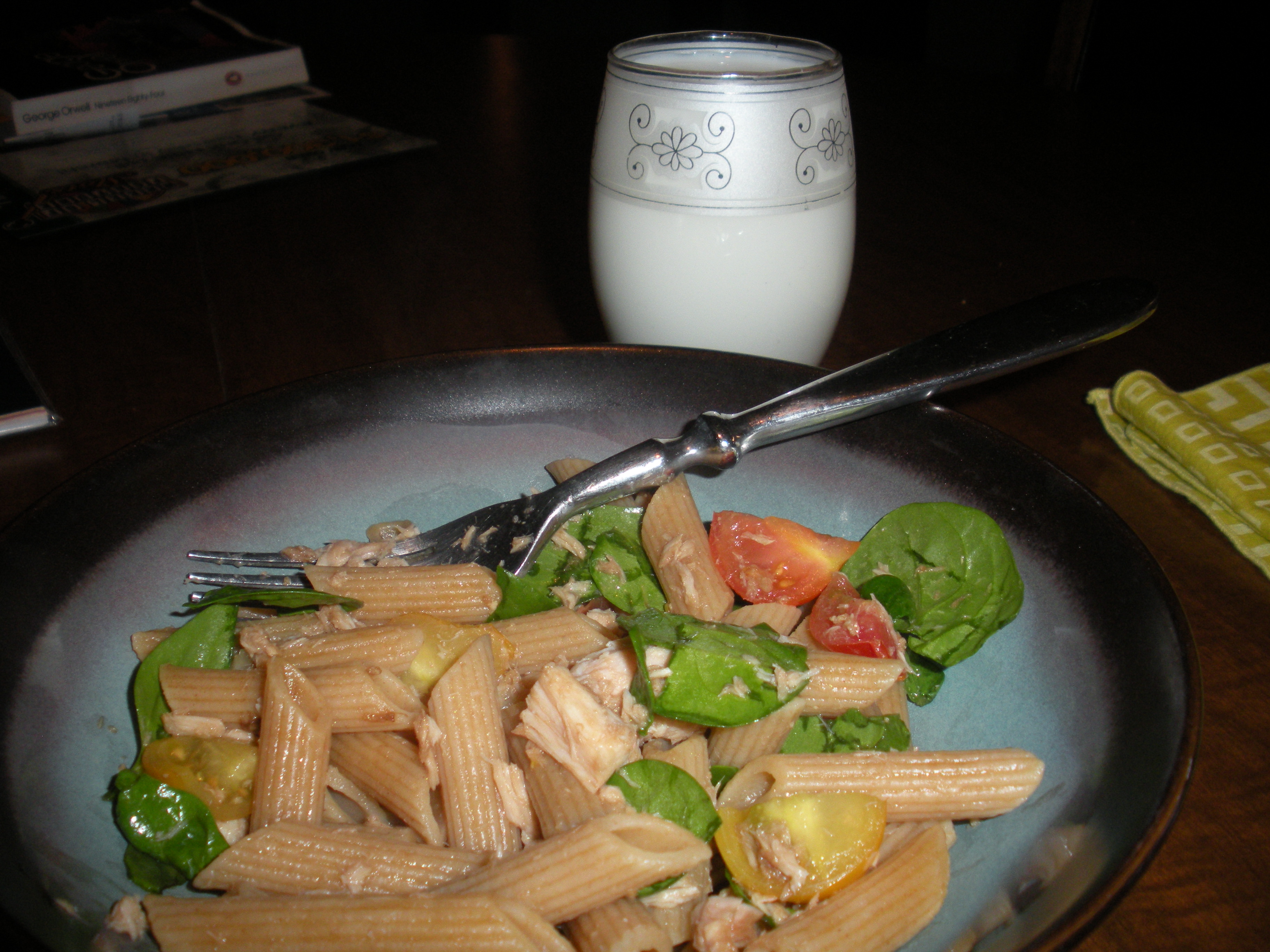
  • 2 oz. whole wheat penne pasta
  • 1/3 can of tuna
  • a few leaves of organic spinach
  • 2 organic cherry tomatoes, chopped
  • a drizzle of olive oil
  • a drizzle of balsamic vinegar
  • 1 small glass of milk

Estimated Cost of Meal = $0.98

Notice how this diet doesn’t contain much fat? I didn’t realize this until Day #5 of the challenge, but I had already exhausted my weekly food budget.

So why this self-imposed exercise in hunger, you might ask? Because while we can go back to our normal $100/week grocery budget + eating out at least once or twice per week, millions of people in the United States and around the world don’t have that option.

Here’s a link to a recent 60 Minutes segment on how poverty, homelessness and hunger affects children in the United States.

And while our government continues to pour money into its defense budget and give tax cuts to the rich, they’re debating cutting the limited funds (less than 1% of our total budget) for international aid by 20%. Coincidentally, during the past week, I’ve been working on a research/writing project that involves interviewing about a dozen people in developing countries on how foreign assistance for HIV-related programs has impacted their provision of services.

The sentiment from the U.S. government seems to be “do more with less,” which means laying people off work in countries with over 50% unemployment. Meanwhile, in the United States, the gap between rich and poor continues to increase. Why can’t the rich share in their abundance?

To learn more about how U.S. politics affects hungry and poor people at home and abroad, and steps you can take to do something about it, visit www.bread.org.

Posted in Becky's Activism, Healthy Living, The Simple Living Experiment | Tagged , , , , , , | 5 Comments

Anthropology of an American Girl Virtual Book Discussion

Anthropology of an American Girl by Hilary Thayer Hamann. Self-published in 2003; Published by Spiegel & Grau in 2010.

Synopsis: This coming-of-age first-person narrative follows the life of Eveline Auerbach from her high school years in East Hampton, New York in the late 1970s through her early adulthood in Manhattan in the 1980s. Central to the story is her love affair with Harrison Rourke, a high school drama instructor/professional boxer.  As Evie tries to find her place in the world, the novel becomes a highly personal, deeply moving account of American womanhood.

About the Author: Hilary Thayer Hamann was born and raised in New York – both in the Hamptons and the Bronx. She counts a BFA in film and television and an MA in cinema studies as some of her degrees and certificates. A very cool CV includes work as an assistant at the National Dance Institute, production of the short film We Real Cool based on a Gwendolyn Brooks poem, and coordinating an international exchange between arts students from the USA and the then-Soviet Union. She currently lives on Long Island.

My Initial Reactions to the Book

First of all, I loved this book – not so much for the plot, but for what it says about American society. At first I was a bit daunted by it being 600 pages, but with its casual language, it’s actually a relatively quick read in comparison to most epic novels. It is probably now among my top 3 favorite book club selections thus far.

The book is divided into 7 parts, beginning in 1979 and ending in 1984. When Evie’s in high school, I loved her commentary about some of the things Americans generally find important in high school life – sports, pep rallies, the prom, college prep. I could definitely relate to her awkwardness, and as you moved on to her college years, you could feel her growing up.

I loved what she says about the frivolity of the bourgeosie in America, how Mark thought he could buy Eveline’s love despite being a complete douche. Although her love for Harrison is central to the story, I almost wished she ended up with Rob – he was her truest friend and didn’t seem privy to the games that men sometimes play.

As Evie narrates her story, I enjoyed the social commentary on events of the day that is told largely through character dialogue. The character who is the best at this is probably Jack –

“Those assholes in Jonestown drank cyanide in Kool-Aid and squirted it into the mouths of babies because it dawned on them that Communism might not take off globally. I mean, if Marx and Engels couldn’t do it, if Lenin, Stalin and Trotsky couldn’t do it, what chance do nine hundred Moonies from broken military families have?” (page 87)

And when Reagan was elected president, the character Anselm notes:

“Look at any totalitarian regime. They succeed by feeding greed, inspiring terror, rewarding complicity. By eradicating shades of gray, by promoting contrasts – black-white, good-evil, in-out, us-them. For those who play, there is wealth, security, respect. For those who do not, there is the pathetic echo of their own enlightened by impoverished voices. It’s all theather, which is why there’s no better messenger for the moment than an actor.” (page 390)

The writing in this novel is absolutely brilliant. What’s most impressive is the history behind its publication. In 2003, the novel was originally published by Vernacular Press, an independent publishing company of which Ms. Hamann was founder and co-owner. After the book’s incredible success among readers who identifed with the awakening of its heroine and the awards and accolades it received, it was picked up by a major publishing house. This make me wonder if the author, like so many talented American writers out there, struggled to be recognized by the conventionalism that largely makes up the high-pressure New York publishing world.

Have you read the book, and if so, what did you think about it? Please post in the comments section below.

Next up for discussion is a recent novel by one of my favorite contemporary writers: The Lovers by Vendela Vida. Discussion begins March 24th.

Posted in Around the World Virtual Book Club, Movie Reviews/Book Reviews | Tagged , , , , , , | Leave a comment

Rock the Red Pump: National Women and Girls HIV/AIDS Awareness Day

Today is National Women and Girls HIV/AIDS Awareness Day, and along with about 1,200 other bloggers around the country, I signed up to be a Red Pump Blogger and dedicate a post to talking about the impact of HIV and AIDS on women. The Red Pump Project raises awareness about the impact of HIV and AIDS on women and girls. Red Pump uses the red shoe as a symbol of empowerment to represent women affected directly and indirectly by HIV and AIDS.
The Red Pump Project

Currently an estimated 300,000 women are living with HIV in the United States. An estimated 1 in 5 people living with HIV do not know their status. Every 9 1/2 minutes someone new becomes infected with HIV in the U.S. alone. While advances in treatment have helped to greatly prolong the lives of people living with HIV and help to make it a chronic, manageable condition, people are still dying from AIDS-related complications in this country.

Here are some links to more information:

  • The Red Pump Project’s blog regularly posts information specifically on the impact of HIV and AIDS on women and girls in the United States.
  • Visit http://www.hivtest.org/ to find a place near you to get an HIV test. I believe having an HIV test is just as important as any health screening. I have been tested 4 times in the last 8 years. With the new oral tests, you don’t even need to have your blood taken!
  • If you’re on Twitter, there will be a townhall meeting today at 1:30 pm CST. Follow the Red Pump Project on Twitter @RedPumpProj.
  • If you live in Atlanta, Charlotte, Chicago or Dallas, check out details on some cool events taking place near you.
  • Check out the Positive Women’s Network website to learn more about the concerns and leadership of women living with HIV in the United States.
Posted in Becky's Activism, Healthy Living | Tagged , , , , | Leave a comment

Hunger Awareness Challenge: The Pre-Challenge Post

As Lent begins today, I’m embarking on a week-long Hunger Awareness Challenge. I read about this challenge in Bread for the World’s 2011 Offering of Letters kit. It’s based on a Global Hunger Challenge that was organized last year by Inter Action.

The premise of the challenge is simple: An estimated 1.5 billion people live on less than $1.25 a day – but what does this mean in our context? What if we could only afford as much food as the average Haitian?

This is where some fancy math came into play. A Haitian living on $1.25 per day is the equivalent of an American spending no more than $34.33 on food for five days. According to Inter Action’s website, here’s how they came up with the figure:

“We reached this number by multiplying $1.25 per day (the majority of Haitians live on this amount or less per day) by the number of Haitian gourdes required to buy an equivalent amount of goods or services in the United States (purchasing power parity), which the World Bank calculated as 24.9 in 2008. The average American spends 15.757% of their income on groceries (this number was unavailable for Haiti), which gave us our final number.”

My husband decided to take up the challenge as well and he will later post his experiences on his blog. However, we decided to use the $34.33 budget for a full 7 days. In comparison to hunger in our own country, the maximum amount that a single person can receive on food stamps per week works out to be around $46 (source).

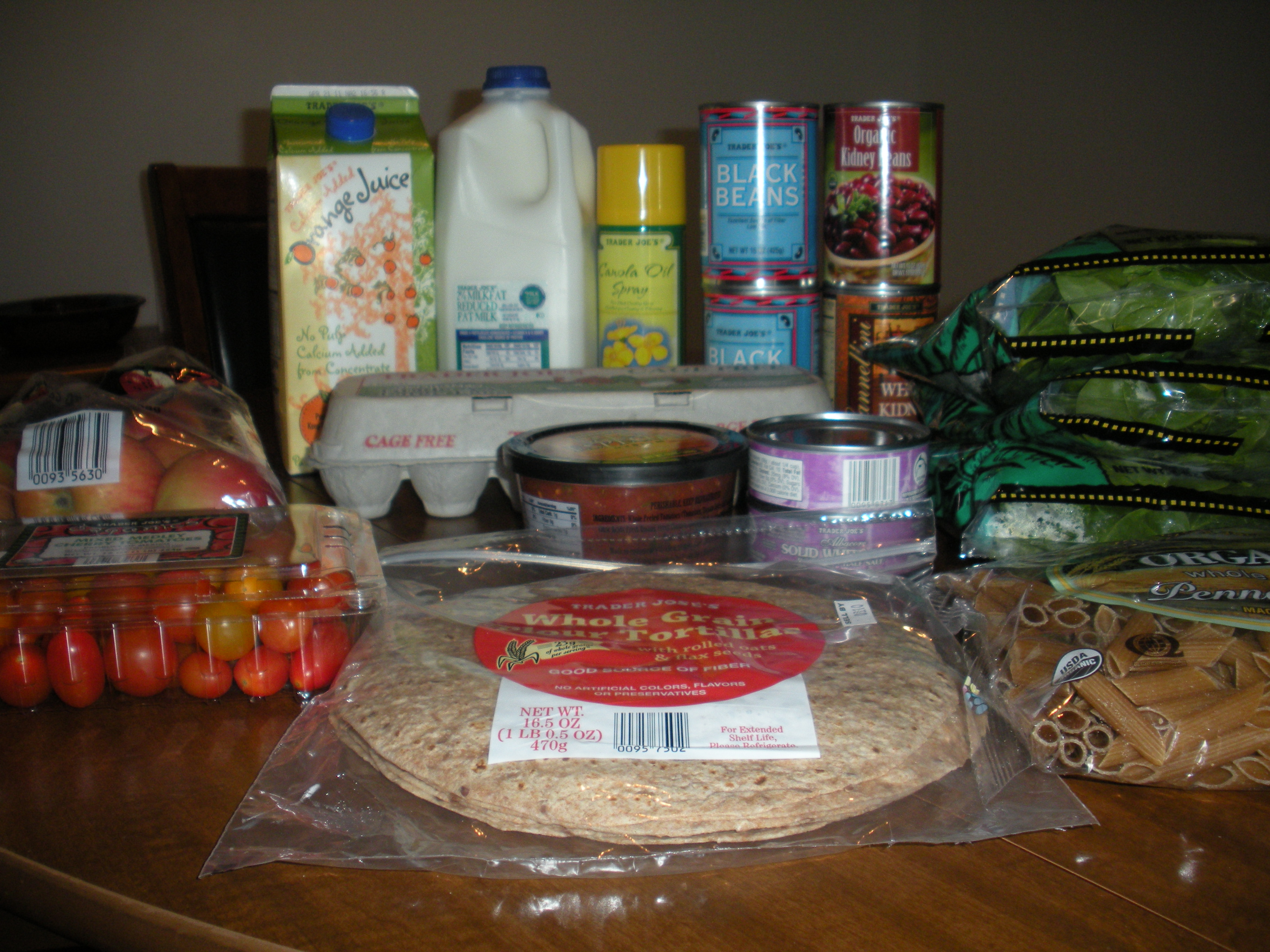
To add to the challenge, I (a) wanted to eat as healthy as possible and (b) wanted to find meals that are relatively quick to prepare, as I have a busy work schedule during the next week. I decided to do my grocery shopping at Trader Joe’s (my favorite grocery store!), because that’s where I’ve generally had the best luck finding healthy products at a low cost. So here’s what I got:

  • 2 cans of albacore tuna = $2.98
  • 1 can of organic kidney beans = $1.19
  • 1 container of salsa = $2.99
  • 3 bags of organic spinach = $5.97
  • 2 cans of black beans = $1.78
  • 1 can of cannellini beans = $0.89
  • 1 large container of organic cherry tomatoes = $3.49
  • 2-pound bag of organic fuji apples = $2.49
  • 1 half-gallon of calcium-added organge juice = $1.99
  • 1 bag of organic whole wheat penne pasta = $1.39
  • 1 carton of cage free, hormone free eggs = $2.49
  • 1 package of whole green tortillas with rolled oats & ground flax seeds = $2.49
  • 1 half-gallon of 2% milk (not organic, but at least rBST-free) = $1.99
  • 1 can of canola cooking spray = $2.29

In total this came to $34.42, just 9 cents over budget. I could have made budget had I opted for a second can of cannellini beans instead of the organic kidney beans, but I didn’t want to hold up the line while I made this exchange. My biggest sacrifices will be spending a week without coffee, tea and wine, but I’d rather go organic on some food and do without these luxuries.

Next week I’ll share my post-challenge reflections, low-cost recipes and I why I think this challenge is important in light of drastic budget cuts our government is trying to push through that will hurt poor and hungry people.

Posted in Becky's Activism, Healthy Living | Tagged , , , , , | 3 Comments